As explained earlier, Samba can help Windows and Unix machines coexist in the same network. However, there are some specific reasons why you might want to set up a Samba server on your network:
-
You don't want to pay for - or can't afford - a full-fledged Windows NT server, yet you still need the functionality that one provides.
-
You want to provide a common area for data or user directories in order to transition from a Windows server to a Unix one, or vice versa.
-
You want to be able to share printers across both Windows and Unix workstations.
-
You want to be able to access NT files from a Unix server.
Let's take a quick tour of Samba in action. Assume that we have the following basic network configuration: a Samba-enabled Unix machine, to which we will assign the name
hydra, and a pair of Windows clients, to which we will assign the names
phoenix and
chimaera, all connected via a local area network (LAN). Let's also assume that
hydra also has a local inkjet printer connected to it,
lp, and a disk share named
network - both of which it can offer to the other two machines. A graphic of this network is shown in
Figure 1.1.
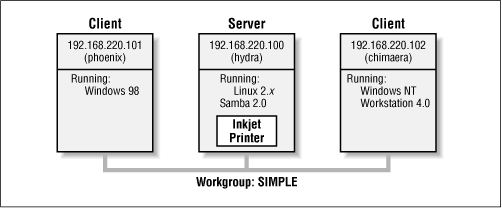
In this network, each of the computers listed share the same
workgroup. A workgroup is simply a group nametag that identifies an arbitrary collection of computers and their resources on an SMB network. There can be several workgroups on the network at any time, but for our basic network example, we'll have only one: the SIMPLE workgroup.