package Apache::MyTemplate;

use strict;
use Apache::Constants qw( :common );
use Template;
use vars qw( $TT );

sub handler {
  my $r = shift;

  # create or reuse existing Template object
  $TT ||= Template->new({
      INCLUDE_PATH  => '/usr/local/tt2/templates',
  });

  my $data = {
      uri => $r->uri,
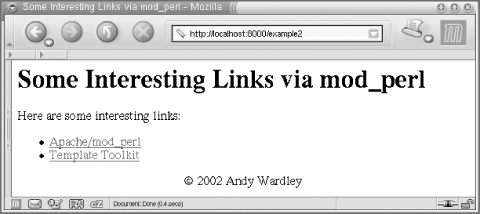
      copyright => '© 2002 Andy Wardley',
      weblinks  => [
           {
            url   => 'https://perl.apache.org/',
            title => 'Apache/mod_perl',
           },
           {
            url   => 'https://tt2.org/',
            title => 'Template Toolkit',
           },
      ],
      # ...and so on...
  };

  $r->content_type('text/html');
  $r->send_http_header;

  $TT->process('example.html', $data, $r) || do {
      $r->log_reason($TT->error( ));
      return SERVER_ERROR;
  };

  return OK;
}
1;